

Have you ever noticed that checks in the UAE don’t usually fail because you forgot at least one document? No, they fail when the story these documents tell is not true. You know the principle. The team is rushing to prepare everything for ISO audits, financial audits, and free zone audits. Policies are approved, reports are signed, and files are organized like a professional. Looks perfect on paper. But then the audits become more active, the same problems occur year after year, and suddenly the certification is at risk. It’s frustrating, isn’t it? You are working, but something is wrong. The real problem? Lack of effort is not what auditors want. Currently, UAE auditors lack good year-end files and corrections. You need concrete evidence that your department is alive and working, year-round, across all departments, even when the pressure is on and no one is looking. Think about it. How can you spot risks before they start? Who’s calling? Who is responsible for remediation? And are your managers really using audit feedback to better manage things? This is a game changer for expectations. Financial metrics are still important, but they are just one whole. True strength shows up in the daily controls that are applied, in the leaders who own them, in the internal audits that work, and in the solutions that actually solve the problem, not just hide it.
In this article, we’ll explain how UAE auditors evaluate your governance beyond the numbers, what they focus on first (and report hard), why so many “fixes” fail, and how successful audits build real trust with regulators, investors, and free zone authorities. Please believe me. In today’s UAE market, this is more than just good to know. This is the secret to rock-solid compliance, trustworthy management, and confidence in long-term prosperity.
How UAE Auditors Look Beyond Numbers to Assess True Governance
| Document Readiness vs System Readiness | System preparation focuses on | Auditors in the UAE are quick to distinguish | Auditors in the UAE are quick to distinguish |
Document readiness and system readiness | How the controls work throughout the year | How the controls work throughout the year | Perfectly designed internal audit report |
| Document preparation focuses on | Are risks identified and monitored internally? | Are risks identified and monitored internally? | net financial statements |
| Completed policies and procedures | How to detect, fix, and verify issues | How to detect, fix, and verify issues | current legislative documents |
| Signed reports and reconciliations | Management awareness and participation | Management awareness and participation | Verified financial records |
How UAE Auditors Assess Governance Maturity, Not just Financial Accuracy
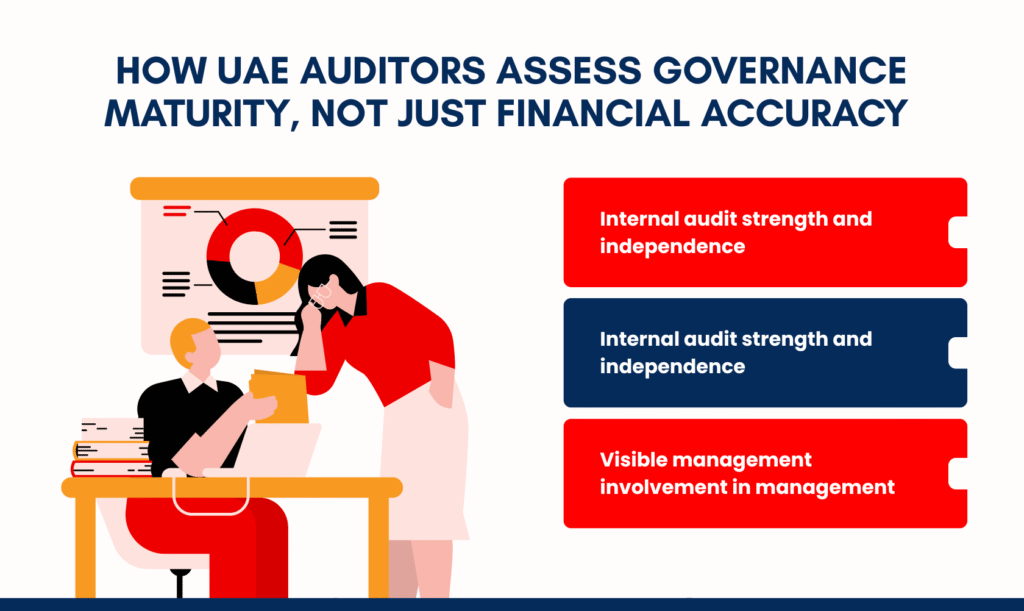
Internal audit strength and independence Auditors check whether internal audit truly provides a strong second line of defense – whether it is free from management influence, focuses on real risks, and provides stable oversight.
Visible management involvement in management Auditors look not just at signatures, but also at how practical controls are performed, including actual review meetings, risk negotiations, and decision-making based on audit results. When management remains passive, it feels more like a compliance regime than true ownership.
Accountability and effectiveness of corrective actions The auditor determines whether the nonconformity will be resolved through actual work to identify the root cause and identify the owner, or whether the nonconformity will be fixed simply for “audit purposes.” Are you constantly making changes without making fundamental improvements? This is a warning sign of a weak management culture.
Also read ics-scada-security-testing
How UAE auditors assess Governance maturity as well as financial accuracy
In the UAE, auditors’ focus is increasingly shifting from what is documented to how management actually functions. Financial accuracy is still important, but it’s no longer enough. During certification, statutory, and regulatory audits, auditors assess whether the governance structure is integrated, consistent, and sustainable.
What auditors actually evaluate during interviews and file reviews
Auditor interviews are designed to check consistency between policy and practice. They assess whether management and process owners understand controls, risks, and decision-making responsibilities. File validation is not just about integrity. Auditors look for logical consistency, evidence of completion, and cross-functional consistency.
Trust in internal audit Auditors assess whether the internal audit function is functioning independently and objectively. This includes considering audit plans, risk assessments, and monitoring mechanisms. If internal audit relies on checklists, lacks depth, or repeatedly identifies the same issues without resolution, external auditors will view this as a control weakness rather than a procedural deficiency.
Management involvement Strong governance is reflected in the visible involvement of leaders. Auditors look for evidence that management has reviewed the audit results, approved corrective actions, and monitored the results. When audit responsibilities are fully delegated to compliance teams without management oversight, it raises concerns about the tone and accountability of senior leaders.
Ownership of corrective actions Auditors monitor how nonconformities are resolved over time. Assess whether corrective actions are clearly defined, realistically planned, and effectively implemented. Repeated expansions, vague plans of action, or responsibilities assigned to “organizations” rather than named roles are indicative of an immature management environment. UAE auditors analyze multi-year trends, including recurring issues, delayed closures and developments. Steady progress and real learning over cycles indicates governance maturity. Endless repetition screams surface-level conformity.
Understanding UAE Finance Laws, What Every Company Should Know
- Dynamic regulatory environment: UAE regulations cover federal laws, central bank regulations, free zones, and emirate-specific powers. Organizations must comply with international standards.
- Commercial Company Law (CCL): Governing corporate structure, governance, reporting obligations, and shareholder protection. Auditors check actual compliance, not just documentation. Central banks and financial authorities: DFSA, ADGM FSRA, and the UAE Central Bank ensure risk management, capital adequacy, accuracy of reporting, and effectiveness of operational management.
- AML and CTF compliance: Focus on risk-based approach, customer due diligence, transaction monitoring, and staff awareness. Defects lead to serious audit findings.
- IFRS Reporting Requirements: Auditors review judgment areas such as revenue recognition, impairment, provisioning, and disclosures; poor documentation or inconsistent application raises red flags.
- Emirate-Specific / Free Zone Mandates: Additional reporting timelines, audit approvals, and governance standards require coordinated compliance across jurisdictions. Stay agile:
- Conduct ongoing regulatory oversight
- Integrate changes into policies, training, and audits
- Document impact assessment
How Weak Internal Audits Lead to Financial Failures in the UAE
In the UAE, many organizations view internal audit as a simple compliance checkbox, one that just ticks ISO certifications and free zone regulations. The problem, however, is that internal audit weaknesses are often the hidden cause behind financial audit failures, regulatory headaches, and even license renewal delays. Spotting this connection is key if your company wants to build stronger governance and nail financial accuracy.
Why Financial Discrepancies Trace Back to Control Failures
Financial audit problems don’t just pop up out of nowhere. Items such as missing reconciliations, misclassification of transactions, and errors in IFRS generally indicate larger control issues. Internal audits are your first line of defense. They are designed to identify gaps in processes, approvals and reporting early on. If we are too superficial or simply act, we will lose sight of these risks and these issues will turn into mandatory financial audits and financial audits in free zones.
How do auditors relate internal audit results to financial risk?
External auditors do not independently examine financial statements. They review internal audit results to truly understand the control environment. If your internal audit is poorly performed (incomplete, inconsistent, or questionably clean), this indicates potential blind spots in your financial processes. In this way, auditors can focus on the areas with the highest risk of misstatements or violations.
Why “pure” internal auditing is questionable
Ironically, an internal audit report with no findings or the same old general notes can actually set off alarm bells. Auditors view overly perfect reports as a sign of superficial checks, poor controls, or a lack of real problems on the part of management. Strong internal auditing isn’t about producing perfect reports, it’s about providing honest, actionable information that identifies risks before they become financial problems.
5 Audit Mistakes Repeatedly by UAE Free Zone Companies and How to Fix Them
- Unorganized entrance. Poorly structured or missing documentation slows down work and increases the risk of non-compliance.
- Solution: Implement standardized record-keeping, version control, and clear filing protocols. IFRS errors: misapplication of standards or inconsistent treatment lead to audit adjustments.
- Fix your accounting team on IFRS and have a clear policy on complex transactions. Bank reconciliation issues: Delayed or erroneous reconciliations create discrepancies between ledgers and statements.
- Fix: Set regular schedules, automate what you can, and get approval from management quickly. Classification errors: Incorrect transaction categories can skew your reports and mess up your results.
- Correct: Establish a clear chart of accounts, regularly review practices, and regularly implement internal controls. Submission of documents is delayed. Missing deadlines for submitting official, free zone, or internal reports creates compliance issues and delays approvals.
- Fix: Create a compliance calendar with alerts and clearly define responsibilities for on-time delivery.
Read what-is-socas-a-service-socaas
Risk based auditing in the UAE Why checklists no longer satisfy auditors
Audit expectations in the UAE go beyond compliance in every respect. Certified auditors are now placing more emphasis on risk-based audits, which focus on how an organization identifies, prioritizes, and controls actual operational and compliance risks. Verifying the existence of a procedure is no longer sufficient. Auditors expect internal audits to reflect an organization’s risk profile, regulatory risk, and operational complexity. Yes/No checklists fail because they do not demonstrate judgment, sampling logic, or evidence-based evaluation.
If all items are shown to be relevant and there are no significant findings, the auditor will ask whether the audit covered the actual implementation or just supporting documentation. The purpose of the risk register is to develop an audit plan by determining which processes need to be tested and how often the tests should be applied. High-risk areas, outsourced activities, and historical issues naturally require more audit attention. UAE certified auditors ultimately look for strong internal controls.
This includes an independent auditor who can explain why the risks were selected, how the evidence was tested and how the results were incorporated into management’s review. Internal audits that identify actual deficiencies, link findings to corrective actions, and inform management decisions demonstrate system maturity. In contrast, “perfect” reviews with no conclusions indicate superficial compliance and often generate deeper scrutiny than trust. Make sure your management team considers not only the implementation of compliance, but also its impact.
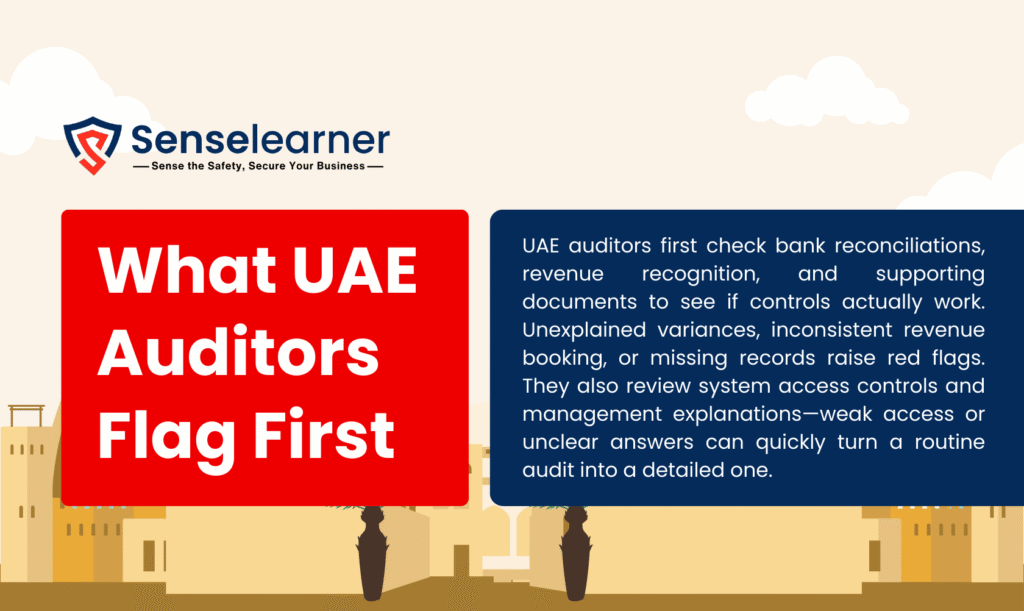
What UAE Auditors Flag First
The first thing UAE auditors look out for when auditing financial statements and internal controls
In the early stages of a financial and legal audit in the UAE, auditors focus on areas that quickly show whether controls are working consistently or exist only on paper. One of the first checks is regarding bank reconciliation. Auditors focus on adjustments that are regularly made, considered, and resolved, rather than year-end adjusted balance sheets. Late or unexplained variances immediately raise concerns about cash flow management and financial health.
Another early trigger is revenue recognition. Auditors assess whether revenue is recorded according to actual service delivery or contractual milestones rather than reporting targets. Inconsistent recognition models, late adjustments, or administrator-initiated fixes often require further testing. Additionally, gaps in documentation such as missing invoices, unclear contracts, and unsupported journal entries indicate weak internal controls and lead to an increased audit sample.
Auditors also pay particular attention to data security and access controls, especially when it comes to financial systems. Weak access controls, shared credentials, or lack of monitoring lead to compliance and integrity issues. Finally, management briefing also plays an important role. If the explanation is unclear, inconsistent, or not supported by evidence, the auditor questions whether the controls are understood or simply maintained for audit purposes. These early indicators help auditors decide whether an audit will remain routine or develop into a detailed audit.
Why Corrective Actions Fail in UAE Audits
Corrective actions are subject to scrutiny in UAE audits as they show whether the organization is actually learning from the results or simply mixing up documentation. Failure often begins with poor root cause analysis, addressing the problem at a superficial level without identifying exactly why the problem occurs. Ambiguous or common root causes immediately alert auditors that similar problems are likely to recur and may reveal ineffective controls rather than isolated errors.
Copy and paste operations are not appropriate Auditors instantly detect identical adjustments among unrelated results. When corrective actions ignore specific processes and associated risks, they appear empty. Tailor-made solutions demonstrate real understanding. The boilerplate response screams conformity theater.
Lack of performance testing undermines confidence Implementing without testing is the same as having zero proofs. Auditors look for evidence (follow-up audits, measurements, monitoring) that the fix actually works. Without it, when activity “stops”, trust collapses, indicating continued weakness.
Disabling controls worsens failures Are the audit results hidden outside the management meeting? This is fatal. A high level of discussion, follow-up, or resource allocation indicates to the auditor that the corrective action only exists on paper. This isolation ensures that compliance violations are not escalated and repeated during administrative checks.
How Audit Builds Trust in the UAE Market
Audits are no longer considered regulatory procedures in the UAE. Regulators, investors, free zone authorities and large corporations increasingly view audit results as an indicator of management strength and reliability. Organizations that view auditing as a tool for continuous improvement gain measurable credibility in the marketplace.
Tender Eligibility and contract preparation Many government and semi-government tenders in the UAE require proof of effective internal controls, completion of corrective actions, and stable certification. Robust audit practices help organizations demonstrate consistent compliance, risk awareness, and operational maturity. Auditors want repeatable processes rather than last-minute solutions that directly impact bid eligibility and evaluation.
Investor and stakeholder trust Investors and partners use audit results to assess management oversight and risk exposure. Clear audit trails, well-documented controls, and timely corrective actions demonstrate transparency and accountability. In the highly competitive UAE market, reliable audit results reduce perceived risk and support smarter investment decisions.
Declining normative trust and control UAE regulators and free zone authorities are closely monitoring how organizations respond to audit findings. Organizations with disciplined audit programs, effective root cause analysis, and management-driven corrective actions are often considered low-risk organizations. This trust allows for smoother inspections, fewer duplicate findings, and more effective regulatory participation. Long-term authentication stability
Organizations focused solely on passing audits often struggle to manage monitoring and recertification cycles. Good audit methodology ensures consistent problem resolution, effective monitoring, and meaningful management reviews. This stability reduces audit fatigue, prevents the risk of decertification, and supports long-term compliance planning.
Beyond complianceWhen auditing is integrated into governance and decision-making, it becomes an assurance tool rather than a compliance checkpoint. In the UAE market, where trust, reputation and regulatory confidence have a direct impact on business growth, rigorous audit practices are a strategic advantage rather than an operational burden.
FAQ’s
Why do UAE auditors focus on management maturity rather than just financial accuracy?
Financial numbers alone cannot prove that controls are working consistently. UAE auditors assess how risks are identified, how decisions are made, and whether management actively monitors controls. Management maturity indicates whether compliance is maintained throughout the year, not just at the time of an audit.
What is the main reason why organizations fail UAE audits despite having complete documentation?
The most common reason is the gap between documentation and actual implementation. Policies may exist, but auditors cannot see the testing of controls, the effectiveness of corrective actions, or evidence of management involvement. This shows the superiority of form over content.
How does weak internal audit affect financial and ISO audit results in the UAE?
Weak internal audits may not detect control gaps quickly enough, and problems can escalate into financial inaccuracies and repeated ISO non-compliance. External auditors rely on the quality of internal audits to assess risk, so cursory internal audits often lead to deeper reviews and expanded testing.
What do UAE auditors expect from corrective actions following audit results?
Auditors expect clear root cause analysis, definition of responsibilities, realistic timelines, and evidence that fixes have been tested and verified.
Copy-pasted answers and actions closed for audit purposes only are considered warning signs of poor management and often lead to repeat conclusions.
Conclusion
In the UAE, a successful audit is not just about passing a test, it is about proving that governance is alive, effective and truly owned by leaders. Auditors have made that clear. Documentation without actual execution introduces risk, corrective action without robust verification undermines credibility, and internal audit without true independence undermines trust. Organizations that continue to treat audits as a check-box activity to be completed once a year will continue to face repeated findings, increased scrutiny, and heightened regulatory tensions.
On the other hand, companies that incorporate auditing into their daily operations (risk-focused internal audits, corrective actions taken by management, and management explicitly involved in the process) demonstrate a level of maturity that goes well beyond basic compliance. Sound audit practices create true trust. These provide reassurance to regulators that controls are in fact working, demonstrate to investors that risks are identified and managed, and allow free zone authorities to rely on stable controls rather than constant intervention.
In the long run, this trust means simpler audits, fewer headaches, and a solid market advantage.
After all, audits are not an obstacle to overcome in the UAE’s highly regulated and reputation-driven environment. Auditing is a smart tool to improve governance, protect financial health, and build long-term trust. Organizations that embrace this change will not just thrive, they will thrive with real confidence.